
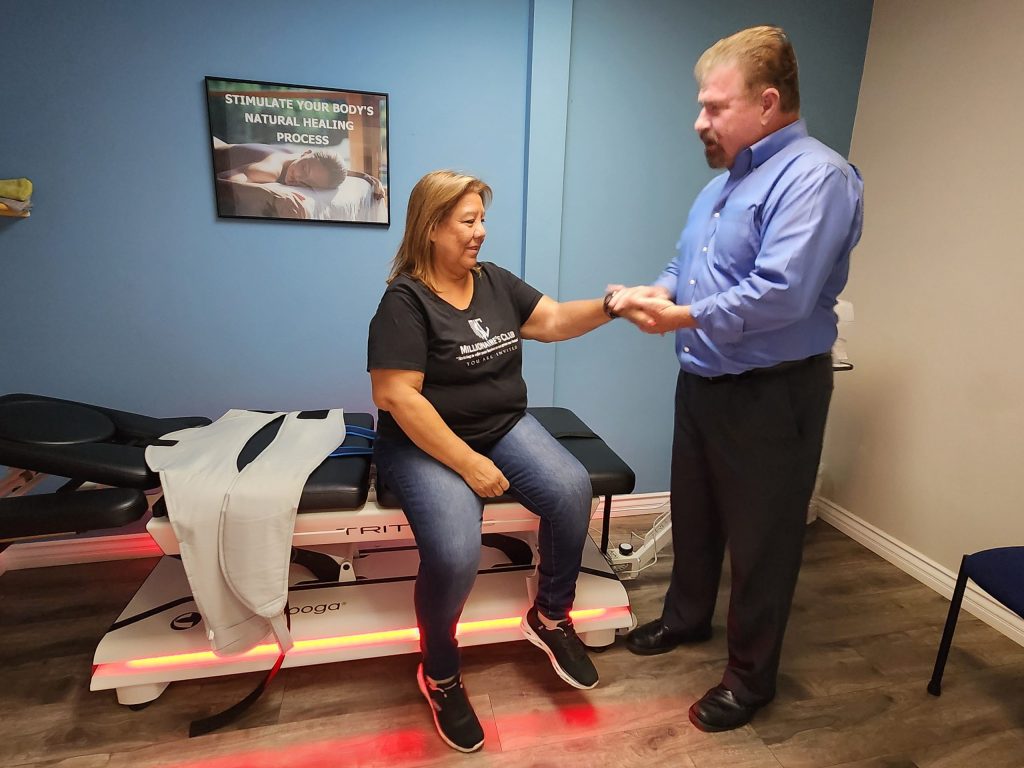
Updated September 23, 2026. Bolt Chiropractic Family Wellness, Oxnard, CA
You’ve tried the pills and the physical therapy, and maybe an injection or two. The disc pain or the burning down your leg keeps coming back. Spinal decompression in Oxnard at Bolt Chiropractic Family Wellness gives you two non-surgical options: Cox® Flexion-Distraction, a doctor-guided technique Dr. Don Bolt, DC, is certified in, and a separate mechanical spinal decompression table. Dr. Bolt selects the method based on your exam and imaging findings.
Dr. Bolt has treated herniated and bulging discs, sciatica, and spinal stenosis in Ventura County for more than 35 years. Care starts with an honest evaluation of your exam and any MRI you bring. If decompression fits, you get a clear plan. If it doesn’t, he’ll tell you and refer you out. Most patients want something simple, like sitting through a grandkid’s ballgame without shifting every five minutes. Request a Chronic Pain Evaluation to see where you stand.
Direct Answer
Spinal decompression in Oxnard at Bolt Chiropractic is non-surgical disc and nerve care using Cox® Flexion-Distraction or a mechanical decompression table, chosen by your findings. Research on flexion-distraction shows it lowers pressure inside the disc, not that discs pull back into place [1], and a 235-patient trial found more pain relief than exercise [2].
TL;DR
- Spinal decompression can mean surgery or non-surgical table care. Bolt Chiropractic offers two non-surgical methods, Cox® Flexion-Distraction and a mechanical decompression table, chosen by your findings [3].
- Dr. Don Bolt, DC, is Cox® Flexion-Distraction certified, with more than 35 years in practice [3].
- Lab research shows pressure drops inside the disc during treatment. It hasn’t shown discs pulling back in living patients [1].
- In a 235-patient trial, flexion-distraction gave more pain relief than exercise, and people with leg pain did significantly better with it [2].
- It’s used for herniated and bulging discs, sciatica, spinal stenosis, and degenerative disc disease.
- Warning signs like loss of bladder control or fever with back pain need a medical provider first [4].
- The first visit gives you an honest answer on fit, with no pressure to commit [5].
One liner: Cox certified, non-surgical spinal decompression in Oxnard, backed by patient trial evidence and an honest evaluation first.
Key Numbers
| Figure | Value | Source |
|---|---|---|
| Adults in the flexion-distraction vs exercise trial | 235 (123 flexion-distraction, 112 exercise) | European Spine Journal, 2006 [2] |
| Donor spines in the disc pressure study | 8, ages 43 to 75, lumbar levels L2 to L5 | Integrative Medicine Reports, 2022 [1] |
| Largest measured pressure drop | 122.0 kPa at L4-L5 in pressurized discs | Integrative Medicine Reports, 2022 [1] |
| Average visits for low back pain, as reported by Cox Technic | 12 visits within 29 days | Cox Technic [6] |
| Laminectomy recovery | Home the same day or 1 to 2 days later, light work after about 4 weeks | MedlinePlus, 2024 [7] |
| Cox certified doctor locator window | Certified or recertified within the past 2 years | Cox Technic [8] |
| Dr. Bolt’s years in practice | More than 35 | Bolt Chiropractic [3] |
What Spinal Decompression Means: Surgical vs Non-Surgical
In short: Spinal decompression can mean surgery, such as a laminectomy, or non-surgical table treatment. Non-surgical care has no incision and lets you try conservative treatment first when your exam supports it.
Spinal decompression means taking pressure off compressed discs and pinched nerves. Non-surgical decompression does it with slow, controlled stretching on a treatment table. Surgical decompression, such as a laminectomy, removes part of a vertebra and sometimes disc tissue to give the nerves more room [7].
Search results for this term mix both kinds, so here’s how they compare.
Table: Non-surgical spinal decompression vs surgery
| Non-surgical (Cox® or mechanical table) | Surgical (laminectomy) | |
|---|---|---|
| How it works | A table gently stretches the spine, with forward bending added in the Cox® method | A surgeon removes bone, bone spurs, or disc tissue [7] |
| Incision | None | Yes |
| Time away | An office visit, and you walk out the same day | Home the same day or 1 to 2 days later, light work after about 4 weeks [7] |
| Known risks | Screened at your exam, since it isn’t a fit for every case | Infection, nerve damage, or partial or no pain relief [7] |
| When it’s used | Disc and nerve pain without warning signs that need a surgeon | When symptoms get more severe and interfere with daily life or work [7] |
NIH lists chiropractic care among the approaches that can improve pain in some people [9]. For patients in Oxnard and across Ventura County, non-surgical spinal decompression lets you try conservative care before an operation, when your exam supports it. When a case needs a surgeon, Dr. Bolt says so.
Cox Flexion-Distraction at Bolt Chiropractic in Oxnard
In short: Cox® Flexion-Distraction gently bends and stretches the spine on a moving table in slow cycles, with the doctor controlling the force. Dr. Bolt is Cox® certified, and the clinic also has a mechanical decompression table for cases where your findings point to it.
Cox® Flexion-Distraction was developed by Dr. James Cox. He graduated from National College of Chiropractic in 1963 and launched the technique in 1973 [10]. It’s a low-velocity form of spinal manipulation done on a specialized Cox® table [6].
Here’s what a Cox session looks like. You lie on a padded table with a lower section that moves. The table slowly bends your spine forward (flexion) and gently stretches it (distraction) in repeated motions. Dr. Bolt controls the motion and the force the whole time, so he can ease off or adjust as your body responds. Cox Technic describes the experience as having “no abrupt movements or noise” [6].
That’s the main difference from a standard adjustment. An adjustment moves a joint with one quick push. Flexion-distraction works in slow, controlled cycles instead, with the pace set by how your back responds that day.
Dr. Bolt is Cox® certified [3]. Cox Technic’s doctor locator lists only doctors certified or recertified within the past two years [8], so you can check the credential yourself before you book.
Two Decompression Methods, Chosen by Your Findings
Cox® Flexion-Distraction isn’t the only decompression option at the clinic. Bolt Chiropractic also has a separate mechanical spinal decompression table [3]. Dr. Bolt selects the method based on what your exam and imaging show, so the table you’re treated on matches your case.
What the Research on Cox Flexion-Distraction Shows
In short: Lab work measured a pressure drop inside donor discs, but it hasn’t shown discs pulling back in living patients. A 235-patient trial found flexion-distraction eased pain more than exercise, especially for leg pain.
You’ll read online that decompression pulls a herniated disc back into place. The research doesn’t show that. What it does show is a measured drop in pressure inside the disc, recorded in a lab on donor spines, plus a patient trial where flexion-distraction gave more pain relief than an exercise program [1][2].
Table: What each study found
| Lab study (2022) | Patient trial (2006) | |
|---|---|---|
| Who was studied | 8 donor spines | 235 adults with chronic low back pain |
| What it found | Pressure inside the lumbar discs dropped during treatment | More pain relief than exercise, and significantly better results for leg pain |
| What it doesn’t show | Discs pulling back in living patients | The same result for every type of back pain |
In the lab study, researchers placed pressure sensors in the lumbar discs and ran a flexion-distraction procedure. Pressure dropped at every level they tested [1]. You’ll often see this called negative intradiscal pressure. The study measured how far the pressure fell at each level. The authors say it “could potentially allow nutrients to flow in and out of the intervertebral discs,” and they note the sample was small and the spines mostly older and worn [1].
The patient trial matters more for you. Both groups improved, but the flexion-distraction group had significantly more pain relief. People with pain running down the leg (radiculopathy, often called sciatica) did significantly better with flexion-distraction [2]. People whose back pain kept coming back improved most with exercise, which is why a plan at Bolt Chiropractic can pair decompression with corrective exercises [11].
Conditions We Treat with Spinal Decompression in Oxnard
In short: Dr. Bolt uses decompression care for herniated and bulging discs, sciatica, spinal stenosis, degenerative disc disease, and post-surgical back pain.
These are the disc and nerve problems Dr. Bolt evaluates most often for decompression care.
Decompression Therapy for Herniated Disc
A herniated disc happens when all or part of a disc is forced through a weak spot in its outer wall [12]. A bulging disc pushes outward without breaking through. Either one can press on a nearby nerve. Decompression therapy for a herniated disc aims to take load off that area, and in the trial above, people with pain running down the leg did significantly better with flexion-distraction than with exercise [2].
Other conditions we see:
- Sciatica: pain, weakness, numbness, or tingling in the leg, caused by pressure on or injury to the sciatic nerve [13]
- Spinal stenosis: a narrowing of the spinal canal or the openings where nerves exit. Symptoms often ease when you sit or bend forward [14], the same direction flexion-distraction works in
- Degenerative disc disease: discs that lose height and cushioning over time, often seen on an MRI
Dr. Bolt also sees failed back surgery and post-surgical spine pain [3]. For severe back pain that hasn’t responded to other care, the clinic’s severe back pain treatment combines decompression with shockwave and therapeutic laser [5]. Neck and back pain after car accidents is common too [15], and the clinic documents personal injury cases for attorneys and insurers when needed [3].
Who Is a Good Candidate, and When We Refer Out
In short: Good candidates have disc or nerve pain that hasn’t settled with medication, therapy, or injections. Warning signs like loss of bladder control or fever with back pain need a medical provider first.
You’re likely a good fit if disc or nerve pain in your back or leg has lasted weeks or months, and medication, physical therapy, or injections haven’t settled it. Many of Dr. Bolt’s patients are active adults and seniors who want to keep walking, traveling, and keeping up with the grandkids [3]. That’s the focus of the clinic’s Senior Spine & Mobility program [16]. Your exam and imaging decide the rest.
Some symptoms need a medical provider before any chiropractic care. MedlinePlus lists these among the signs to get checked right away [4]:
- Back pain after a severe blow or fall
- Loss of control over urine or stool
- Unexplained fever with back pain
- A history of cancer
- Difficulty walking or keeping your balance
If any of these apply, contact a medical provider right away. And if your exam shows decompression isn’t the right tool, Dr. Bolt will tell you and refer you out [3].
What Your First Visit Looks Like
In short: The first visit covers your health history, an exam, a review of any imaging, an honest answer on fit, and a plan if you go ahead, with no pressure to commit.
Your first appointment follows the same five steps for every new patient [5]:
- A health history covering your pain timeline and past treatments
- A clinical exam focused on your back
- A review of any MRI, X-ray, or medical records you bring
- An honest answer on whether decompression fits your case, and which method suits your findings
- A clear treatment plan if you decide to move forward
Bring your imaging reports if you have them. If you don’t, the clinic offers X-rays [17]. Veterans can use VA Community Care. Bring your VA authorization or referral and the office handles the rest [3]. There’s no pressure to commit at the first visit [5].
Spinal Decompression in Oxnard: Frequently Asked Questions
Is spinal decompression painful?
It’s designed to be gentle. Cox Technic describes flexion-distraction as having “no abrupt movements or noise” [6]. Dr. Bolt controls the force throughout and eases off if an area feels sore.
How many sessions will I need?
That depends on your condition and is set at your exam [5]. For context, Cox Technic reports an average of 12 visits within 29 days for low back pain [6]. Your own plan may be shorter or longer.
What if my back pain keeps coming back?
Recurring pain often needs more than table work. In the 235-patient trial, people whose pain kept returning improved most with an exercise program [2]. That’s why Dr. Bolt can pair decompression with corrective exercises that help you stay on track after your sessions [11].
Is Cox flexion-distraction the same as spinal decompression?
Cox® flexion-distraction is one non-surgical way to decompress the spine [6]. It combines gentle bending and stretching on a specialized table, guided by a doctor trained in the technique. Bolt Chiropractic also has a separate mechanical spinal decompression table, and Dr. Bolt selects the method based on your findings [3].
Does decompression therapy work for a herniated disc?
It can help. In a trial of 235 adults with chronic low back pain, flexion-distraction gave more pain relief than an exercise program, and people with leg pain did significantly better with it [2]. Lab research shows pressure drops inside the disc, but it hasn’t shown discs pulling back in living patients [1].
Can a chiropractor pop a herniated disc back into place?
No, and flexion-distraction doesn’t try to. There’s no pop or quick thrust, only slow bending and stretching [6]. Research shows a pressure drop inside the disc during treatment, not a disc pushed back into place, and the patient evidence is about pain relief [1][2].
Do I need an MRI before my first visit?
No. Bring any MRI or X-ray reports you have, and Dr. Bolt will review them [5]. If you need imaging, the clinic offers X-rays [17].
Can I go back to work after a session?
There’s no surgical recovery to plan around. Each session is an office visit with no incision, unlike a laminectomy, where light work usually resumes after about 4 weeks [7]. Dr. Bolt will tell you about any activity limits for your case at your exam.
Do you see patients from outside Oxnard?
Yes. The clinic is at 445 W. 5th Street in Oxnard, and patients come from Camarillo, Ventura, Port Hueneme, Thousand Oaks, and across Ventura County for non-surgical spinal decompression [3].
Book a Chronic Pain Evaluation in Oxnard
In short: Call (805) 985-6867 or request an evaluation online to find out whether decompression fits your case.
Spinal decompression in Oxnard starts with a straight answer about your case. Dr. Bolt is Cox® certified with more than 35 years in practice [3]. He’ll review your exam and imaging, build a clear plan with the method that fits your findings, and refer you out if decompression doesn’t fit. Call (805) 985-6867 or request an appointment online [18].
Definition Bank
| Term | Plain definition |
|---|---|
| Spinal decompression | Taking pressure off compressed discs and pinched nerves. |
| Non-surgical spinal decompression | Decompression done with controlled table motion, with no incision. |
| Cox® Flexion-Distraction | A low-velocity chiropractic technique that bends and stretches the spine on a specialized table. |
| Mechanical spinal decompression table | A separate treatment table that gently stretches the spine to take pressure off discs and nerves. |
| Flexion | Bending the spine forward. |
| Distraction | Gently stretching the spine lengthwise. |
| Negative intradiscal pressure | A drop in pressure inside a spinal disc. |
| Herniated disc | A disc forced partly or fully through a weak spot in its outer wall. |
| Bulging disc | A disc that pushes outward without breaking through. |
| Sciatica | Pain, weakness, numbness, or tingling in the leg from pressure on the sciatic nerve. |
| Radiculopathy | Pain that runs along a nerve, such as down the leg. |
| Spinal stenosis | Narrowing of the spinal canal or the openings where nerves exit. |
| Laminectomy | Surgery that removes part of a vertebra to give nerves more room. |
Entity Cards
Cox® Flexion-Distraction
| Property | Value |
|---|---|
| Developer | Dr. James Cox [10] |
| Launched | 1973 [10] |
| Type | Low-velocity spinal manipulation [6] |
| Equipment | The Cox® table [6] |
| Evidence | Disc pressure study, 2022 [1]. Randomized trial, 2006 [2] |
Dr. Don Bolt, DC
| Property | Value |
|---|---|
| Credentials | Doctor of Chiropractic, Cox® Flexion-Distraction certified [3] |
| Experience | More than 35 years [3] |
| Decompression methods | Cox® Flexion-Distraction and mechanical spinal decompression, selected by patient findings [3] |
| Practice | Bolt Chiropractic Family Wellness, 445 W. 5th Street, Oxnard, CA 93030 [3] |
| Programs | Senior Spine & Mobility [16], VA Community Care [3] |
Sources
- Gudavalli MR, Cramer GD, Patwardhan AG. Changes in Intradiscal Pressure During Flexion-Distraction Type of Chiropractic Procedure: A Pilot Cadaveric Study. Integrative Medicine Reports, 2022. https://journals.sagepub.com/doi/full/10.1089/imr.2022.0002
- Gudavalli MR, Cambron JA, McGregor M, et al. A randomized clinical trial and subgroup analysis to compare flexion-distraction with active exercise for chronic low back pain. European Spine Journal, 2006;15(7):1070-1082. https://link.springer.com/article/10.1007/s00586-005-0021-8
- Bolt Chiropractic Family Wellness. Meet the Doctor: Dr. Don Bolt, D.C. https://boltchiro.com/meet-the-doctor/
- MedlinePlus Medical Encyclopedia. Low back pain: acute. Last reviewed June 17, 2024. https://medlineplus.gov/ency/article/007425.htm
- Bolt Chiropractic Family Wellness. Severe Back Pain Treatment in Oxnard, Ventura and Camarillo. https://boltchiro.com/severe-back-pain-treatment/
- Cox Technic. The Technic. https://coxtechnic.com/the-technic
- MedlinePlus Medical Encyclopedia. Laminectomy. Last reviewed November 7, 2024. https://medlineplus.gov/ency/article/007389.htm
- Cox Technic. The System (certified doctor locator). https://coxtechnic.com/the-system
- National Institute of Neurological Disorders and Stroke. Pain. Last reviewed March 13, 2026. https://www.ninds.nih.gov/health-information/disorders/pain
- National University of Health Sciences. COX Technic Seminars at NUHS: History of COX Technic. https://www.nuhs.edu/academics/continuing-education/cox-technic/
- Bolt Chiropractic Family Wellness. Corrective Exercises. https://boltchiro.com/corrective-exercises/
- MedlinePlus Medical Encyclopedia. Herniated disk. Last reviewed August 27, 2024. https://medlineplus.gov/ency/article/000442.htm
- MedlinePlus Medical Encyclopedia. Sciatica. Last reviewed August 27, 2024. https://medlineplus.gov/ency/article/000686.htm
- MedlinePlus Medical Encyclopedia. Spinal stenosis. Last reviewed August 27, 2024. https://medlineplus.gov/ency/article/000441.htm
- Bolt Chiropractic Family Wellness. Auto Injuries. https://boltchiro.com/auto-injuries/
- Bolt Chiropractic Family Wellness. Senior Spine and Mobility Program in Oxnard, CA. https://boltchiro.com/senior-spine-mobility-program-in-oxnard-ca/
- Bolt Chiropractic Family Wellness. X-Rays. https://boltchiro.com/x-rays/
- Bolt Chiropractic Family Wellness. Appointments: Request a Chronic Pain Evaluation. https://boltchiro.com/appointments/