
Updated September 28, 2026, Bolt Chiropractic Family Wellness, Oxnard, CA
If your MRI report says “disc bulge” or “herniated disc,” and someone has already mentioned surgery, you probably have more questions than answers. As a herniated disc chiropractor in Oxnard, Dr. Don Bolt works with many patients who arrive this way, often after physical therapy, injections, or medication haven’t worked. That includes veterans with service-related back pain.
Our herniated disc treatment in Oxnard starts without surgery and with one question: what is your disc actually doing? The answer starts with the words on your report.
Direct Answer
A bulging disc and a herniated disc are different MRI findings, and bulges show up in 30% of pain-free 20-year-olds and 84% of pain-free 80-year-olds. That’s why herniated disc treatment in Oxnard at Bolt Chiropractic starts with an exam, then a non-surgical plan built around Cox Flexion-Distraction.
TL;DR
- Under the radiology standard used on MRI reports, a bulging disc is not a form of herniation [1].
- Herniations are protrusions or extrusions, and an extrusion that breaks off is a sequestration [1].
- Disc bulges appear in 30% of pain-free 20-year-olds and 84% of pain-free 80-year-olds, so the exam decides what the MRI means [2].
- “Degenerative disc disease” means disc wear plus symptoms thought to come from it, not an imaging finding by itself [1].
- Care at Bolt Chiropractic may combine Cox Flexion-Distraction, adjustments, therapeutic laser, and corrective exercise.
- Discectomy relieves symptoms more effectively when symptoms call for surgery, but for most people it follows other treatment and time [3][5].
- Loss of bladder or bowel control needs medical care right away [6].
One liner: Your MRI wording matters, but your exam matters more, so disc care in Oxnard starts with an evaluation before any talk of surgery.
Key Numbers
| Figure | Value | Source |
|---|---|---|
| Pain-free people in the imaging review | 3,110 across 33 studies | [2] 2015 |
| Disc bulge in pain-free 20-year-olds | 30% | [2] 2015 |
| Disc bulge in pain-free 80-year-olds | 84% | [2] 2015 |
| Disc protrusion in pain-free adults, age 20 to 80 | 29% to 43% | [2] 2015 |
| Disc degeneration in pain-free adults, age 20 to 80 | 37% to 96% | [2] 2015 |
| Typical size of a disc bulge | Usually less than 3 mm | [1] 2014 |
| Share of disc edge in a bulge | Usually more than 25% | [1] 2014 |
| Point where back pain counts as chronic | 12 weeks | [7] 2020 |
| Laser session length at Bolt Chiropractic | About 10 to 20 minutes | [9] 2026 |
Bulging Disc vs Herniated Disc: What Your MRI Report Means
In short: A bulging disc is not a herniated disc. A bulge covers a wide stretch of the disc’s edge, while a herniation pushes out in one localized spot.
A bulging disc and a herniated disc are not the same finding. Under the standard terms radiologists use, a bulge is disc tissue that extends past the edges of the vertebrae over a wide stretch of the disc, usually more than a quarter of the way around and less than 3 mm out, and it “is not considered a form of herniation” [1]. A herniation is disc material pushed out past the disc’s normal edge in one localized spot [1].
Each disc has a tough outer ring, the annulus fibrosus, and a soft gel center, the nucleus pulposus. Think of a car tire, where a bulge is like a tire low on air that sags outward along a wide stretch of the sidewall. A herniation is more like a blister in one spot. The pushed-out material can be the gel center, the outer ring, or both [1].
Herniations are sorted into two main shapes, protrusion and extrusion. An extrusion that breaks off is called a sequestration [1].
| MRI term | What the disc is doing | Counts as a herniation? |
|---|---|---|
| Bulge | Tissue extends past the edges of the vertebrae over a wide stretch, usually more than a quarter of the way around and less than 3 mm out | No |
| Protrusion | Material is pushed out in one localized spot, and the part that sticks out is narrower than its base | Yes |
| Extrusion | The pushed-out material is wider than its base in at least one direction | Yes |
| Sequestration | A piece of extruded disc has broken off and lost contact with the disc | Yes |
So if your report reads “diffuse disc bulge at L4-L5,” it isn’t describing a herniation. That difference changes what the next step should be.
Why the MRI Alone Does Not Explain Your Pain
In short: Disc bulges are common in people with no pain, so an exam decides whether yours is the problem.
Disc changes show up on plenty of people who have no back pain at all. A Mayo Clinic-led review of 33 studies covering 3,110 pain-free adults found disc bulges in 30% of 20-year-olds and 84% of 80-year-olds [2].
| Finding in people with no back pain | Age 20 | Age 80 |
|---|---|---|
| Disc degeneration | 37% | 96% |
| Disc bulge | 30% | 84% |
| Disc protrusion | 29% | 43% |
The same radiology standard makes the point in plain terms. Calling a disc “bulging” does not “imply the presence of symptoms” [1].
When a herniation in the low back presses on a nerve, you may feel sharp pain in part of the leg, hip, or buttock, with numbness in other spots and sometimes leg weakness. Pain often gets worse after sitting or standing, at night, or when you sneeze or cough [5].
None of this means your MRI is wrong or unimportant. It means the picture needs a person attached to it. The disc on your report may be the source of your leg pain, or it may be background wear that was there before the pain started. A hands-on exam of your reflexes, strength, feeling, and movement is how we tell the difference. That’s why your first visit includes a review of any images you bring.
Degenerative Disc Disease in Oxnard: What the Label Means
In short: Degenerative disc disease means wear plus symptoms, so care targets the level where both line up.
“Degenerative disc disease” sounds like something that spreads. The radiology standard defines it as disc wear plus symptoms thought to come from that wear [1]. It also warns that the phrase “carries implications of illness that may not be appropriate” when the only evidence comes from imaging [1].
On an MRI, a worn disc can look drier and darker, which some reports call a “dark” or “black” disc [1]. It may lose height, and advanced wear can cause a bulge [1][2]. By age 80, 96% of people without back pain show disc degeneration [2].
Heavy lifting, repeated bending, long sitting or standing, extra weight, inactivity, and smoking all raise the risk of a herniated disc [5]. Smoking can also restrict blood flow to the discs and speed up wear [7]. If your disc problem started with a car crash, our auto injuries page covers that side of care.
So we don’t treat wear by itself. We look for the level where your wear lines up with your symptoms, such as pain with long sitting or pain that travels into a leg. Then we build care around the movement and pressure at that level. For patients in Oxnard and across Ventura County, that means a plan built from your exam.
How We Treat Herniated and Bulging Discs Without Surgery
In short: Care combines Cox Flexion-Distraction, adjustments, laser, and exercise over a series of visits.
Once the exam points to the disc level behind your pain, care has two goals: take pressure off the irritated nerve and get your back moving well again. Care usually combines more than one treatment over a series of visits.
| Treatment | What happens | Why it’s in the plan |
|---|---|---|
| Cox Flexion-Distraction | You lie on a padded table that gently flexes and stretches the low back | Hands-on decompression aimed at the disc level from your exam |
| Chiropractic adjustment | Gentle, specific motion to stiff joints near the problem level | Aims to restore movement around the disc |
| Therapeutic laser | Light therapy over the painful area, usually 10 to 20 minutes [9] | Aims to calm irritated nerves and soft tissue |
| Corrective exercise | Targeted movements that retrain how your body moves | Aims to build the support your spine needs to hold gains |
Dr. Bolt is certified in Cox Flexion-Distraction. Its developer describes it as a spinal manipulation technique that includes spinal decompression [4]. The North American Spine Society lists spinal manipulation as an option for symptom relief in lumbar disc herniation with nerve pain [3]. Its work group also sees a limited course of structured exercise as an option for mild to moderate symptoms [3].
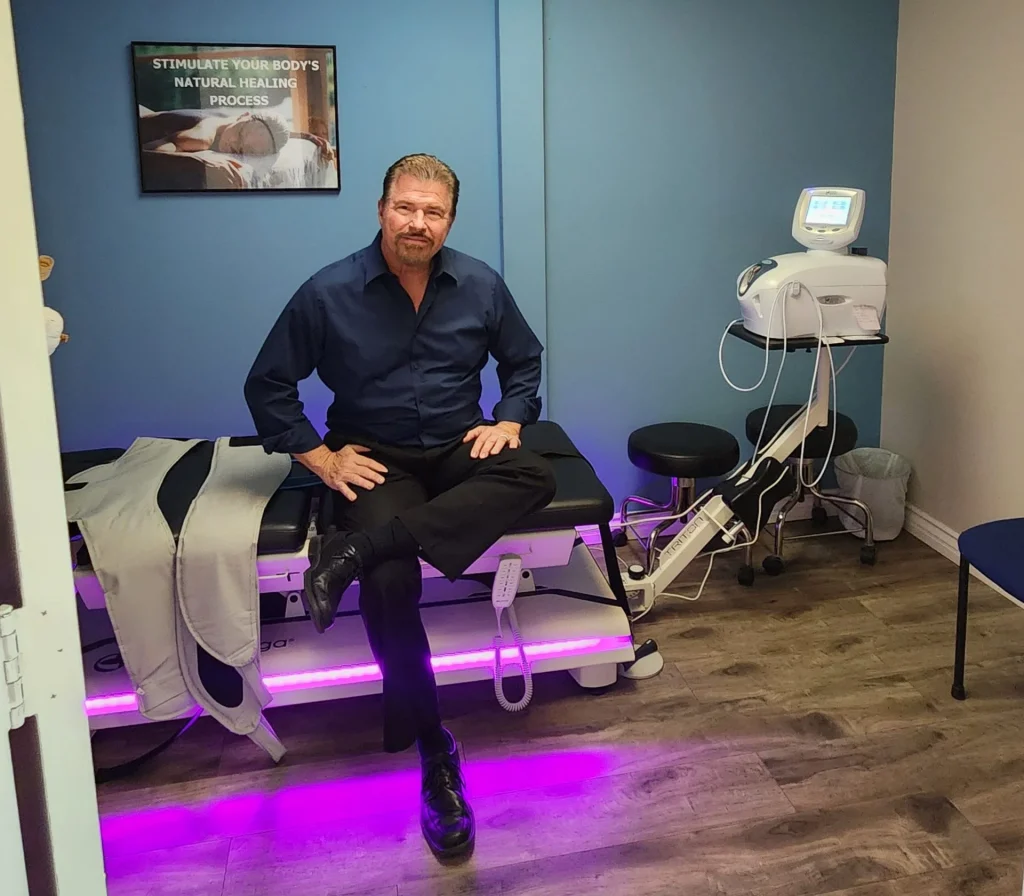
This is a course of care, planned and checked against your progress as you go. You can see how the table works on our non-surgical decompression page. Veterans can use VA Community Care at our office.
When Surgery Is the Right Call
In short: Surgery helps when symptoms call for it, and bladder or bowel changes need care right away.
Surgery has a real place in disc care. A discectomy removes all or part of the disc [5]. For people whose symptoms call for surgery, the North American Spine Society finds it gives more effective relief than non-surgical care [3]. For most people, though, surgery is an option after other treatments and time haven’t worked [5].
Some symptoms shouldn’t wait for any plan. Get medical care right away if you have:
- Loss of control over urine or stool
- Weakness or numbness in your buttocks, thigh, leg, or pelvis
- Unexplained fever with back pain
- Back pain after a severe fall or blow [6]
In rare cases, a ruptured disc presses on the bundle of nerve roots at the base of the spine. This is called cauda equina syndrome, and untreated it can cause permanent nerve damage [7].
If you can’t control your bladder or bowels, don’t wait for a chiropractic visit. Call your doctor or get urgent medical care now [6].
If your exam shows nerve weakness that is getting worse, or your pain isn’t changing with care, we’ll tell you plainly. Then we’ll help you find the right specialist.
Your First Visit With a Herniated Disc Chiropractor in Oxnard
In short: The first visit covers history, exam, imaging review, and a clear plan with no pressure.
Your first visit starts with a full history and exam. Dr. Bolt reviews any imaging and past care you bring, then decides whether decompression, shockwave, or laser fits your case. You get a clear explanation of your options, with no pressure [8].
Bring your MRI report, and the images if you have them. If your main problem is back pain without a named disc finding, our severe back pain treatment page covers that path.
You’ll leave knowing whether your disc is the likely source of your pain and what we’d do about it. Call (805) 985-6867 or request a chronic pain evaluation at our office at 445 W. 5th Street in Oxnard.
Herniated Disc Treatment FAQ
Is a bulging disc the same as a herniated disc?
No. Under the radiology standard, a bulge is disc tissue that extends past the edges of the vertebrae over a wide stretch of the disc, usually more than a quarter of the way around and less than 3 mm out, and it is not a form of herniation. A herniation is disc material pushed out past the disc’s normal edge in one localized spot [1].
Can a chiropractor make a herniated disc worse?
That risk is why the exam comes first. Spinal manipulation isn’t appropriate when there’s an underlying cause such as osteoporosis or spinal cord compression, so we check for those before any hands-on care [7].
Can a herniated disc get better without surgery?
Most people improve with treatment. Surgery is usually an option when symptoms don’t go away with other treatments and time [5].
Do I need an MRI before my first visit?
No. If you have an MRI or other imaging, bring the report and images, and Dr. Bolt will review them with your exam [8].
How long does a herniated disc take to get better?
Pain, numbness, or weakness often goes away or improves a lot over weeks to months. Getting back to all your activities without strain can take several months to a year or more [5].
Can a herniated disc happen in the neck?
Yes. A herniated disc in the neck can cause pain when you move your neck, deep pain near the shoulder blade, or pain that moves into the upper arm [5].
Definition Bank
| Term | Plain-English definition |
|---|---|
| Herniated disc | Disc material pushed out past the disc’s normal edge in one localized spot [1]. |
| Bulging disc | Disc tissue that extends past the edges of the vertebrae over a wide stretch of the disc, usually more than a quarter of the way around and less than 3 mm out. Not a form of herniation [1]. |
| Annulus fibrosus | The tough outer ring of a spinal disc [1]. |
| Nucleus pulposus | The soft gel center of a spinal disc [1]. |
| Protrusion | A herniation where the part that sticks out is narrower than its base [1]. |
| Extrusion | A herniation where the pushed-out material is wider than its base in at least one direction [1]. |
| Sequestration | An extruded piece of disc that has broken off and lost contact with the disc [1]. |
| Degenerative disc disease | Disc wear plus symptoms thought to come from that wear [1]. |
| Dark disc | A disc that looks darker on MRI because it has dried out. Also called a black disc [1]. |
| Discectomy | Surgery that removes all or part of a herniated disc [5]. |
| Cox Flexion-Distraction | A table-based technique described by its developer as spinal manipulation that includes spinal decompression [4]. |
| Cauda equina syndrome | A ruptured disc pressing on the bundle of nerve roots at the base of the spine [7]. |
| Chronic back pain | Back pain that lasts 12 weeks or longer [7]. |
Entity Cards
Herniated disc
| Property | Value |
|---|---|
| Types | Protrusion, extrusion, sequestration [1] |
| Material | Gel center, outer ring, or both [1] |
| Confirmed by | MRI plus exam |
| Surgery | Discectomy [5] |
Bulging disc
| Property | Value |
|---|---|
| Counts as herniation | No [1] |
| Typical size | Usually less than 3 mm [1] |
| Pain-free prevalence | 30% at age 20, 84% at age 80 [2] |
Degenerative disc disease
| Property | Value |
|---|---|
| Definition | Disc wear plus related symptoms [1] |
| Imaging signs | Dark disc, height loss, bulge [1][2] |
| Pain-free prevalence of degeneration | 37% at age 20, 96% at age 80 [2] |
Bolt Chiropractic Family Wellness
| Property | Value |
|---|---|
| Location | 445 W. 5th Street, Oxnard, CA 93030 |
| Phone | (805) 985-6867 |
| Doctor | Dr. Don Bolt, DC, Cox Flexion-Distraction certified |
| Experience | Over 35 years in practice |
| Veterans | VA Community Care accepted |
| Disc care | Cox Flexion-Distraction, adjustments, therapeutic laser, corrective exercise |
Sources
- Fardon DF, Williams AL, Dohring EJ, Murtagh FR, Gabriel Rothman SL, Sze GK. Lumbar disc nomenclature: version 2.0. Recommendations of the combined task forces of the North American Spine Society, the American Society of Spine Radiology and the American Society of Neuroradiology. The Spine Journal, 2014;14(11):2525-2545. https://www.thespinejournalonline.com/article/S1529-9430(14)00409-4/fulltext
- Brinjikji W, Luetmer PH, Comstock B, et al. Systematic literature review of imaging features of spinal degeneration in asymptomatic populations. American Journal of Neuroradiology, April 2015;36(4):811-816. https://www.ajnr.org/content/36/4/811
- Kreiner DS, Hwang SW, Easa JE, et al. An evidence-based clinical guideline for the diagnosis and treatment of lumbar disc herniation with radiculopathy. North American Spine Society. The Spine Journal, 2014;14(1):180-191. Guideline summary via Guideline Central. https://www.guidelinecentral.com/guideline/9905/
- Cox Technic. What is Cox Technic flexion-distraction. Accessed September 23, 2026. https://www.coxtechnic.com/
- MedlinePlus, US National Library of Medicine. Herniated disk. Reviewed August 27, 2024. https://medlineplus.gov/ency/article/000442.htm
- MedlinePlus, US National Library of Medicine. Low back pain, acute. Reviewed June 17, 2024. https://medlineplus.gov/ency/article/007425.htm
- National Institute of Neurological Disorders and Stroke. Low Back Pain fact sheet, NIH Publication No. 20-NS-5161, March 2020. https://www.ninds.nih.gov/sites/default/files/migrate-documents/low_back_pain_20-ns-5161_march_2020_508c.pdf
- Bolt Chiropractic Family Wellness. What to Expect on Your First Visit, homepage. Accessed September 23, 2026. https://boltchiro.com/
- Bolt Chiropractic Family Wellness. Therapeutic Laser Therapy. Accessed September 23, 2026. https://boltchiro.com/therapeutic-laser-therapy/